Normal Fault Dependent Traps: Validation, Risk Mitigation and Volume
(with co-instructor Victor Somerfeld)
Course Length
3 days (light version) to 5 days (full version)
Course Overview
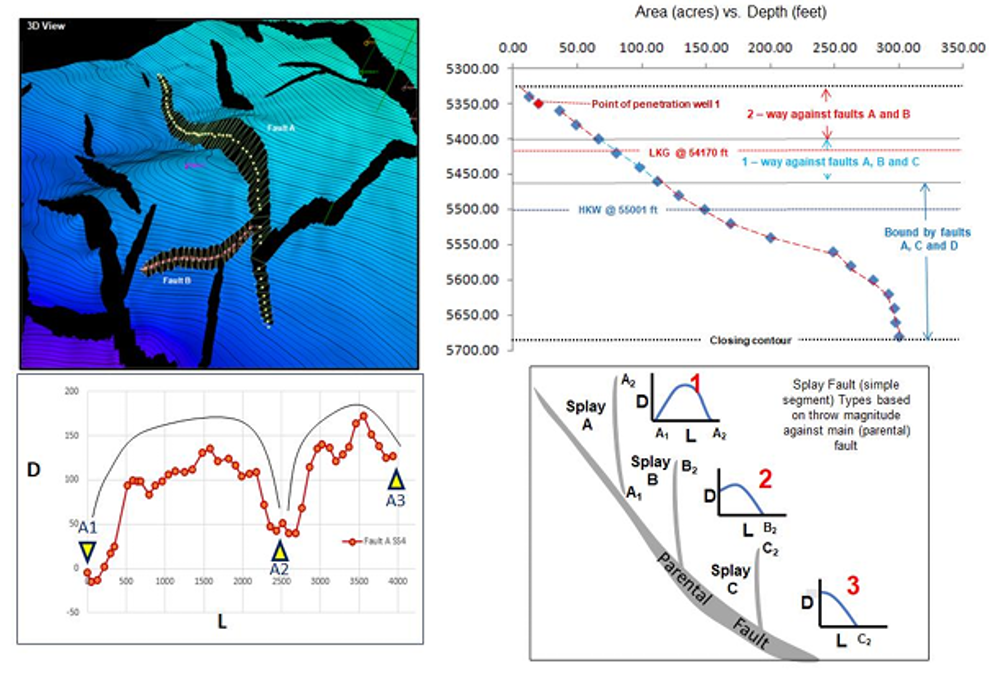
Traps associated with normal (dip-slip) faults, including three-way dip closures against a fault or two-way dip closures against two faults, represent common occurrences in hydrocarbon accumulations. The lateral (along-strike) coalescence of these faults may be either partial or complete. Partial coalescence introduces a notable risk of hydrocarbon leakage and may lead to inaccuracies in volume estimations. Utilizing displacement analysis, especially through displacement versus distance plots, emerges as a powerful tool to discern the segmentation of risk within fault-dependent closures. When coupled with depth versus area plots, this approach enables the discrimination of various segments within a trap, each carrying different risks. In this course, we delve into (i) a comprehensive review of the primary characteristics of normal faults and their growth, (ii) the definition of their different seismic expressions in 3D and 2D, and (iii) the use of the displacement analysis and depth versus area plots to quantify their risks and estimate their role in the geometry of traps. Emphasis is placed on the critical role that faults play in container (trap) and retention (seal) aspects, underscoring their importance in the exploration and evaluation of hydrocarbon resources. Exercises are based on 3D and 2D seismic.
Target Students
Geologists and geophysicists actively working in exploration, development, and production.
Contents
The self-similar (fractal), scale independent behavior of normal faults
Overview of Fault Terminology (footwall, hanging wall, throw, dip separation, displacement, heave, cutoff, tip, splay, gouge, smear)
How Faults grow
Development of a single fault by lateral propagation; development of a fault system by linkage of individual fault segments.
Displacement analysis
Displacement (D) – length (L) analysis
Types of D-L profiles along a fault segment
Types of D-L profiles across fault segments
Maximum displacement analysis
Quantification of displacement along faults (D-L plots) in seismic, workflows
Techniques for separating or linking faults and their characteristic shapes on D-L plots
Extrapolation of trap geometry based on uncomplete seismic coverage or coarse 2D grids
Displacement (D) versus depth (Z) analysis
Quantification of displacement along faults (D-Z plots) in seismic, workflows
Techniques to discriminate displacement changes trough time, reactivation of faults
Timing risk (i.e., post charge breach)
Other trap geometries related to normal faults
Splay Faults: their relationship with parental faults and derived trap geometries
Fault polarity Relay Ramps (footwall and hanging wall propagation)
Area vs. Depth (A-D) plots
Construction of Area vs. Depth (A-D) plots and related trapping component thresholds
Leak zones
How do you relate the trapping elements to p90, p10 areas and trap risk
Integration with well data
Risk segmentation of traps
Combined (D-L plot - A-D plot) trap analysis
How do you relate the trapping elements to p90, p10 areas and trap risk
How to avoid overestimating resources; more realistic GRVs (gross rock volumes)
Across fault sealing
Cross-fault displacement graphical assessment
Juxtaposition analysis from seismic data
Calculating SGR (shale gouge ratio) and how to assess its sealing effectiveness
Summary standard workflow to assess trap and seal risks (container and juxtaposition/ gouge)